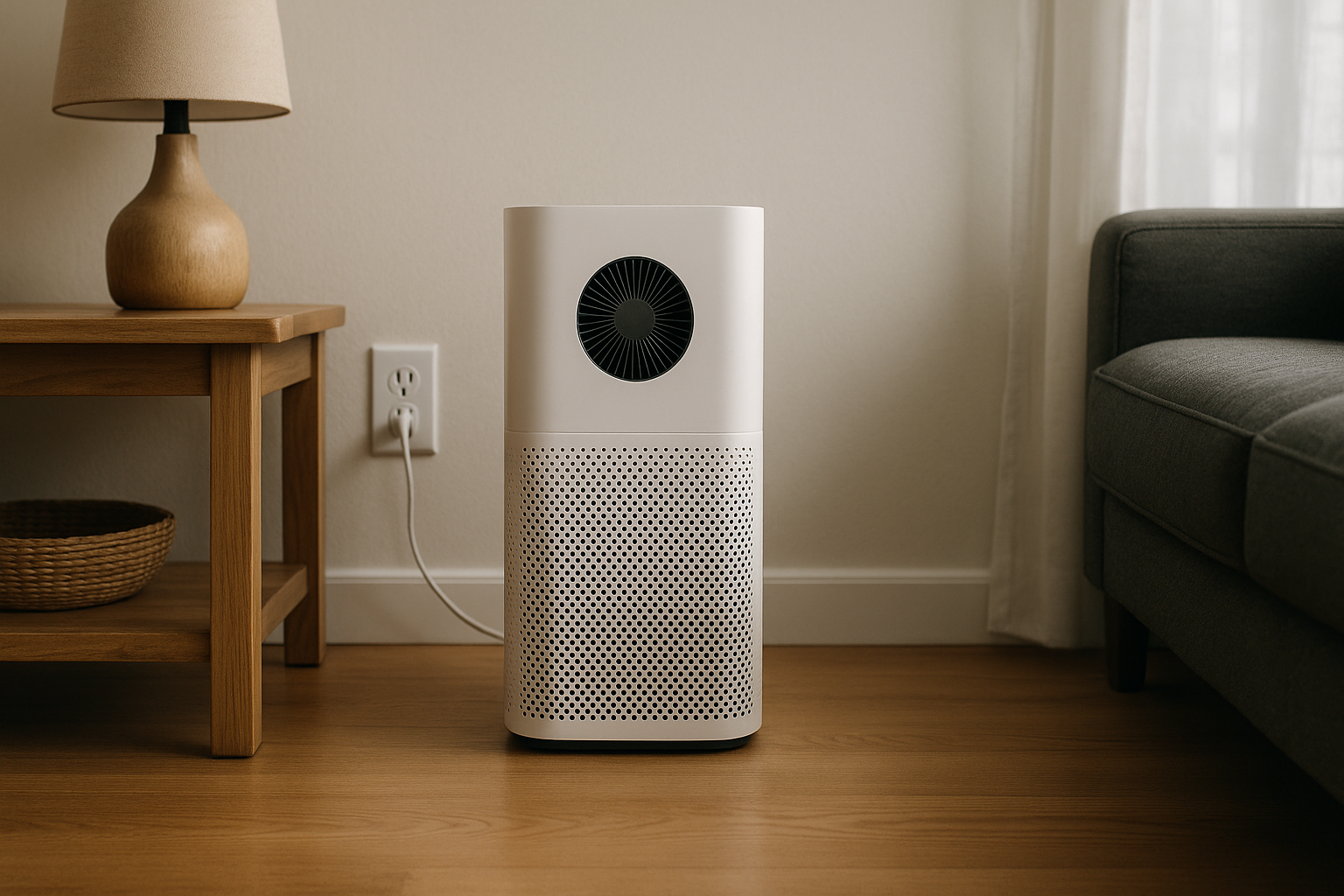
How to Calculate Your Air Purifier's Monthly Electricity Cost
A mid-size air purifier running 24/7 costs most households between $3 and $10 per month in electricity. That's less than a Netflix subscription for most models — but the range is wide enough that the specific unit you own (or are shopping for) matters a lot.
To get your actual number, you need three things: the purifier's wattage, how many hours per day you run it, and your local electricity rate. Everything else is just multiplication.
Here's the process:
- Find the wattage on the unit's label or in the manual
- Multiply watts × daily hours to get watt-hours per day
- Divide by 1,000 to convert to kilowatt-hours (kWh)
- Multiply by your electricity rate (check your last utility bill — the US average is about $0.16/kWh as of 2024)
- Multiply by 30 for a monthly figure
Example: A 45-watt purifier running 24 hours a day uses 1.08 kWh per day. At $0.16/kWh, that's about $0.17/day, or roughly $5.18/month.
The Simple Formula: Watts, Hours, and Kilowatt-Hours Explained
Kilowatt-hours are what your utility company charges you for. One kWh = running a 1,000-watt device for one hour. Most air purifiers are nowhere near 1,000 watts, which is why their electricity cost is relatively modest.
The formula looks like this:
(Watts ÷ 1,000) × Hours Per Day × 30 × Electricity Rate = Monthly Cost
Plug your numbers in. If you don't know your exact rate, $0.16/kWh works as a US baseline, but Hawaii residents pay closer to $0.38/kWh, while parts of the Midwest sit around $0.10/kWh. Those differences matter when you're running a device constantly.
Average Wattage by Air Purifier Size and Room Coverage
Air purifier energy consumption scales with room coverage, but not always in a linear way. Here's a realistic breakdown:
| Room Size | Typical Wattage Range | Example Models |
|---|---|---|
| Small (up to 200 sq ft) | 15–30W | Levoit Core 300, Winix 5500-2 on low |
| Medium (200–400 sq ft) | 30–55W | Coway AP-1512HH, Blueair Blue Pure 211+ |
| Large (400–800 sq ft) | 50–100W | Winix 5500-2, Levoit Core 400S |
| Whole-room/commercial (800+ sq ft) | 100–200W | IQAir HealthPro Plus, Austin Air HealthMate |
The Levoit Core 300 at max speed draws about 45W. The Coway Airmega 400 — designed for 1,560 sq ft — can hit 66W at max speed. The IQAir HealthPro Plus tops out around 215W, which starts to add up.
Smaller units aren't always cheaper to run if you need multiple to cover your home. One 66W unit covering 1,500 sq ft often costs less than three 25W units running simultaneously.
Monthly Cost Estimates for Popular Air Purifier Models
These estimates use $0.16/kWh and assume 24/7 operation at medium fan speed, which is how most people actually use them:
- Levoit Core 300 (25W at medium): ~$2.88/month
- Coway AP-1512HH "Mighty" (32W at medium): ~$3.69/month
- Winix 5500-2 (37W at medium): ~$4.26/month
- Blueair Blue Pure 211+ (30W at medium): ~$3.46/month
- Levoit Core 400S (42W at medium): ~$4.84/month
- Coway Airmega 400 (54W at medium): ~$6.22/month
- IQAir HealthPro Plus (87W at medium): ~$10.03/month
- Austin Air HealthMate (60W constant): ~$6.91/month
The air purifier running cost for most people falls between $3 and $7/month. IQAir and Austin Air units — both premium, heavy-duty machines — push closer to $10/month, but they're built for serious air quality issues like wildfire smoke or severe allergies.
How Fan Speed Settings Dramatically Affect Your Electricity Bill
This is where most people leave money on the table. Running a purifier on max speed continuously can cost 2–4x more than running it on low or medium.
The Coway AP-1512HH is a good example: - Low speed: ~8W → $0.92/month - Medium speed: ~32W → $3.69/month - High speed: ~58W → $6.67/month
That's a $5.75/month difference between low and high. Over a year, that's nearly $70 on a single appliance.
The practical answer: run it on high when you're cooking, cleaning, or when air quality is noticeably bad. Drop to medium or low during normal periods. Most modern units with auto mode do this automatically using onboard air quality sensors — and that's genuinely useful, not a gimmick.
True HEPA vs. Ionic vs. UV Air Purifiers: Which Costs Less to Run?
True HEPA purifiers use a fan to push air through a dense filter. The fan motor is the main electricity draw. These are the most common type, and their wattage is predictable and steady.
Ionic air purifiers (like the Winix models with PlasmaWave, or older Sharper Image Ionic Breeze units) generate charged ions to attract particles. Some models use almost no power — 5 to 15W — because there's no strong fan. The Molekule Air Pro, which combines ionic and HEPA filtration, runs around 30W. The tradeoff: ionizers have been criticized for producing trace ozone and being less effective at capturing particles than true HEPA filters.
UV air purifiers add a UV-C lamp to the mix. The lamp typically adds 5–10W on top of the fan motor. That's not huge — maybe $0.50–$1.00 extra per month — but UV effectiveness in consumer units is debatable. The bulb exposure time is often too short to meaningfully neutralize pathogens.
For pure air purifier electricity cost per month, ionic units win on power draw. But if you want proven particle filtration, true HEPA is worth the slightly higher wattage.
Hidden Energy Costs: Standby Mode, Auto Mode, and Sleep Mode
Standby mode on most purifiers draws 1–3W. Doesn't sound like much, but at $0.16/kWh, a 2W standby costs about $0.23/month — basically nothing. Don't lose sleep over it.
Auto mode is actually your friend here. Units like the Coway AP-1512HH and Winix 5500-2 have air quality sensors that automatically drop fan speed when the air is clean. In practice, auto mode can reduce electricity use by 30–50% compared to running on medium constantly. Real-world tests show the Coway averaging around 20W in auto mode over 24 hours — closer to $2.30/month.
Sleep mode typically runs the fan at minimum speed and dims the display. For the Levoit Core 400S, sleep mode drops consumption to about 5W. If you run it in sleep mode all night (8 hours) and medium during the day (16 hours), your actual daily wattage averages out much lower than max-speed calculations suggest.
Annual Electricity Cost vs. Filter Replacement Cost: The Full Picture
Here's something most electricity-cost comparisons miss: filters often cost more per year than electricity.
Take the Coway AP-1512HH: - Annual electricity cost (auto mode, 24/7): ~$27 - Replacement HEPA filter (every 12 months): ~$20–$25 - Carbon pre-filter (every 6 months, 2x/year): ~$18 total
Total annual running cost: roughly $65–$70
Now the IQAir HealthPro Plus: - Annual electricity cost: ~$120 - Replacement filter set (every 2–4 years, prorated): ~$100–$150/year - Total: $220–$270/year
That IQAir produces genuinely exceptional air quality — HyperHEPA filtration captures particles down to 0.003 microns. But you're paying for it in both filter and electricity costs. For most homes, the Coway or a similar mid-range unit hits a much better cost-to-performance ratio.
How to Read Your Air Purifier's Energy Star Rating to Predict Costs
Energy Star certified air purifiers meet efficiency standards set by the EPA. Look for the blue Energy Star label when shopping.
Energy Star purifiers must be at least 25% more efficient than standard models in their class. The certification also requires the unit to have a sleep mode and auto mode — which, as discussed, genuinely reduces real-world consumption.
The Energy Star website (energystar.gov) lists certified models with their annual energy consumption in kWh. Find your model, multiply by your electricity rate, done. For example, if a model lists 75 kWh/year and you pay $0.16/kWh, that's $12/year, or about $1/month.
Most Energy Star-certified purifiers in the 200–400 sq ft range clock in at 60–100 kWh/year.
Practical Tips to Cut Your Air Purifier's Running Costs Without Sacrificing Air Quality
- Use auto mode. If your unit has an air quality sensor, let it manage fan speed. It won't run at full blast when it doesn't need to.
- Right-size the unit. A purifier rated for 600 sq ft in a 300 sq ft bedroom runs on low constantly, uses less power, and the filter lasts longer.
- Keep filters clean. A clogged filter makes the motor work harder, increasing wattage. Vacuum pre-filters monthly.
- Close windows when running. You're filtering outside air for free if windows are open — and the unit will run harder trying to keep up.
- Put it in the right spot. Central placement away from walls improves airflow efficiency, so the unit doesn't have to work as hard.
- Run higher speed for short bursts rather than medium all day. Blast it for an hour after cooking, then drop to low.
Is Running an Air Purifier 24/7 Worth the Electricity Cost?
For most people, yes — with caveats. At $3–$7/month for a mid-size HEPA unit, the electricity cost is low enough that it's not a meaningful financial burden. And air quality doesn't stay clean on its own; particles, dust, and allergens regenerate constantly from cooking, pets, people, and outdoor infiltration.
The question really is: do you need it running 24/7? If you have allergies, asthma, a pet that sheds, or live near a highway, yes, continuous operation makes sense. If you live alone in a relatively clean environment, running it during waking hours and using sleep mode overnight is a reasonable compromise that trims costs without much sacrifice.
Air Purifier Electricity Cost vs. Other Household Appliances
To put the numbers in perspective:
| Appliance | Monthly Electricity Cost (avg use) |
|---|---|
| Refrigerator | $15–$20 |
| Window AC unit | $40–$80 |
| LED TV (8 hrs/day) | $3–$5 |
| Mid-size air purifier (24/7) | $3–$7 |
| Phone charger | <$1 |
| Desktop computer (8 hrs/day) | $6–$12 |
An air purifier running constantly costs about as much as your TV. It's not zero, but it's not the energy hog some people assume. The real expense to budget for is filters — not kilowatt-hours.
Next step: Pull out your last utility bill, find your rate per kWh, and run the formula with your specific model's wattage. If you don't own a unit yet, filter replacement cost and room coverage should factor into your decision at least as much as the purchase price — because those are the costs you'll keep paying.